

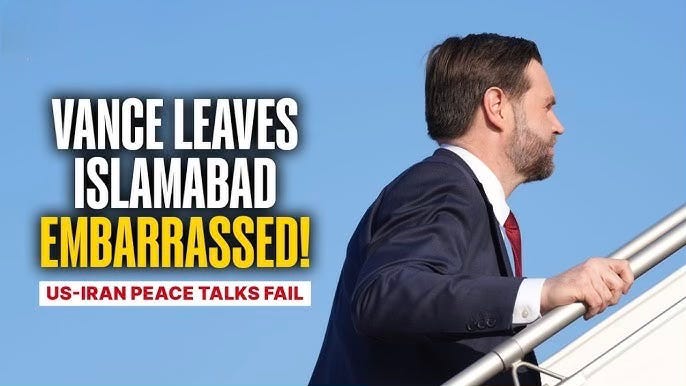
Of course the one-day negotiations with Iran failed. After being forced to fly half-way around the world to talk to the Iranians in their neighboring state of Pakistan, the most inept vice-president in American history flew home in defeat, trailed by Trump’s billionaire son-in-law and his billionaire golf partner. This team has been unable to negotiate anything of lasting value anywhere. Why would we expect them to negotiate Iran’s surrender? It took a year of work by America’s top professionals, including John Kerry, Wendy Sherman, Ernie Moniz and Rob Malley under the skilled leadership of Barack Obama to solve this problem. Trump’s Three Amigos didn’t stand a chance.
The New York Times this morning does a great job of summarizing what it calls “a humiliating strategic defeat” in its editorial, “Four Ways Trump’s War Is Weakening America.” Rather than do my own version, I excerpt their key points below. I disagree, however, with their weak conclusion and present my own at the end.
Before I summarize the NYT, let me highlight one stunning point. Almost all the nations that build or want to build nuclear weapons do so for one main reason: security. They want a weapon that can deter other nations from attacking them. If you hit me; I will destroy you.
Iran now has a better weapon. It is one that does not incur the risks and vulnerabilities of trying to build a bomb. Iran now controls the passageway for one-fifth of the world’s oil and natural gas. Until we free ourselves from the tyranny of fossil fuels, this gives Iran an enormous deterrent. It is a vast power that they did not practically possess before Trump launched the stupidest war in American history. Controlling the Strait is the equivalent of a nuclear arsenal.
Here is how the Times puts it.
The most tangible blow to the United States and the world is the increased influence that Iran has secured over the global economy by weaponizing the Strait of Hormuz. About 20 percent of the world’s oil and liquefied natural gas flows through the strait, which is next to Iran’s southern shore.
Before the war, Iran’s leaders feared that blocking traffic would invite new economic sanctions and a military attack. Once the attack happened anyway, Iran closed the strait to nearly all traffic except its own ships. The policy is inexpensive because it mostly involves a threat, namely that a drone, missile or small boat may blow up a tanker. Forcibly reopening the strait, by contrast, would require an enormous military operation potentially including ground troops and an extended occupation.….For now, Iran appears to have won diplomatic leverage that it could have only dreamed of six weeks ago….
The second setback is to America’s military standing around the world. This war, together with recent U.S. assistance to Ukraine, Israel and other allies, has burned through a substantial portion of the stockpile of some weapons, such as Tomahawk missiles and Patriot interceptors (which can shoot down other missiles). Experts believe the Pentagon used more than one-quarter of its Tomahawk missiles just in the war against Iran. Returning the stockpile to its previous size will take years, and the United States will have to make tough choices about where to maintain its military strength in the meantime. Already, the Pentagon has pulled missile defenses from South Korea.
The war has also revealed that the U.S. military is vulnerable to new ways of warfare. America used billions of dollars’ worth of high-tech munitions to destroy Iran’s traditional air and naval forces, while Tehran used cheap, disposable drones to halt traffic through the Strait of Hormuz and hit targets in the region. The world saw how a country that spends one-hundredth of what the United States does on its military can seek to outlast it in a conflict. It is a reminder of the urgent need to reform America’s military….
The war’s third big cost is to America’s alliances. Japan, South Korea, Australia, Canada and most of Western Europe refused to support the United States in this war — unsurprisingly, given Mr. Trump’s treatment of them. When he demanded their help in reopening the Strait of Hormuz, most allies declined. These countries will remain allies in important ways, but they have made clear that they no longer consider the United States a reliable friend. They are working to build stronger relationships with one another so that they can better resist Washington in the future. “Perhaps the greatest long-term damage to the United States from the Iran war will be in its relationships with allies around the world,” Daniel Byman of the Center for Strategic and International Studies in Washington wrote on Wednesday….
The fourth setback is to America’s moral authority. For all the flaws of this country, it remains a beacon to many around the world. When pollsters ask people where they would move if they could, the United States is consistently the runaway No. 1 answer. America’s appeal stems not only from its prosperity but also from its freedom and democratic values. Mr. Trump has undercut those values for his entire political career and perhaps never more than in the past week, when he made odious threats to erase Iranian civilization. His secretary of defense, Pete Hegseth, made a series of bloodthirsty remarks, including a threat to offer “no quarter, no mercy for our enemies.”
Those would be war crimes. Mr. Trump and Mr. Hegseth have embraced a brutal approach to armed conflict that the United States led the world in rejecting after World War II. By doing so, they have undermined the foundations of America’s global leadership, which claims to place human dignity at the center of an argument for a freer and more open world.
The Times concludes this powerful summary of Trump’s failures with a weak suggestion: “The best hope now may sound naïve, but it remains true. Mr. Trump should at long last recognize the ineptitude of his impulsive, go-it-alone approach. He should involve Congress and seek help from America’s allies to minimize the damage from his war.”
Trump won’t do any of those things. He is a lunatic bereft of any strategy save an animal instinct for survival. Our only hope is to topple his regime. We should look to the example of the brave Hungarian patriots who have built a massive movement that will force Trump’s hero, Victor Orban, from office today. The No Kings movement is our equivalent. I have no doubt that we will end Trump’s mad reign as activist groups — including all my colleagues in the arms control and disarmament organizations — understand that they must merge their efforts into this mighty mass movement.
Then we can begin the enormous work of tearing down his imperial monuments, reversing his insane executive orders and restoring government institutions that help Americans rather than terrorize them.
This is the equivalent of a random person trying their hand at playing a concerto at Carnegie Hall, failing and blaming the venue or the orchestra. It takes years to learn the craft of diplomacy. The Iranians know their stuff. Of course Vance can’t just wing it. But how would he know since we have gotten rid of the whole nuclear negotiations team at State? So embarrassing.
I appreciate the succinct analysis of the colossal missteps and vast incompetence (and cowardice) that brought us to this current moment when the players on the world stage are moving too quickly to track, and the US is utterly lost in a fog of unreality.
That said, I find it difficult to see a way out of the morass. "No Kings" had a decent, far from awe-inspiring, turnout...with no clear direction or momentum.
Even if Democrats manage to flip both chambers in the midterms, and several state legislatures, Trump's MO has been to ignore Congress and act by fiat. I don't see this changing until his term ends, assuming he leaves office.