

In April of 2003, three weeks into the invasion of Iraq, Terry Gross asked me on her NPR show, Fresh Air, to explain how the United States had gotten itself into that war. I told her the answer was not complicated — if you were willing to follow the paper trail.
A small, well-organized group of ideologues had spent a decade building the intellectual and institutional architecture for exactly that moment. They had written the documents, staffed the administration, waited for their opening, and when September 11 provided it, they drove the country to war. Iraq, I told her, was not the end. It was the beginning.
I am writing this now, in the spring of 2026, because we are living through the sequel.
Donald Trump has attacked Iran — without a credible threat, without a coherent strategy, and without apparent awareness of what comes next. As I watch the maneuvers of U.S. forces in the region and read the administration’s scattered, contradictory justifications, I hear the echo of everything we said twenty-three years ago. The theory of victory is the same. The delusions are the same. The consequences may be worse.
Let me take you back to that interview. (You can listen to the original here.) Because what I described then is, I believe, the essential prehistory of the war we are in now.
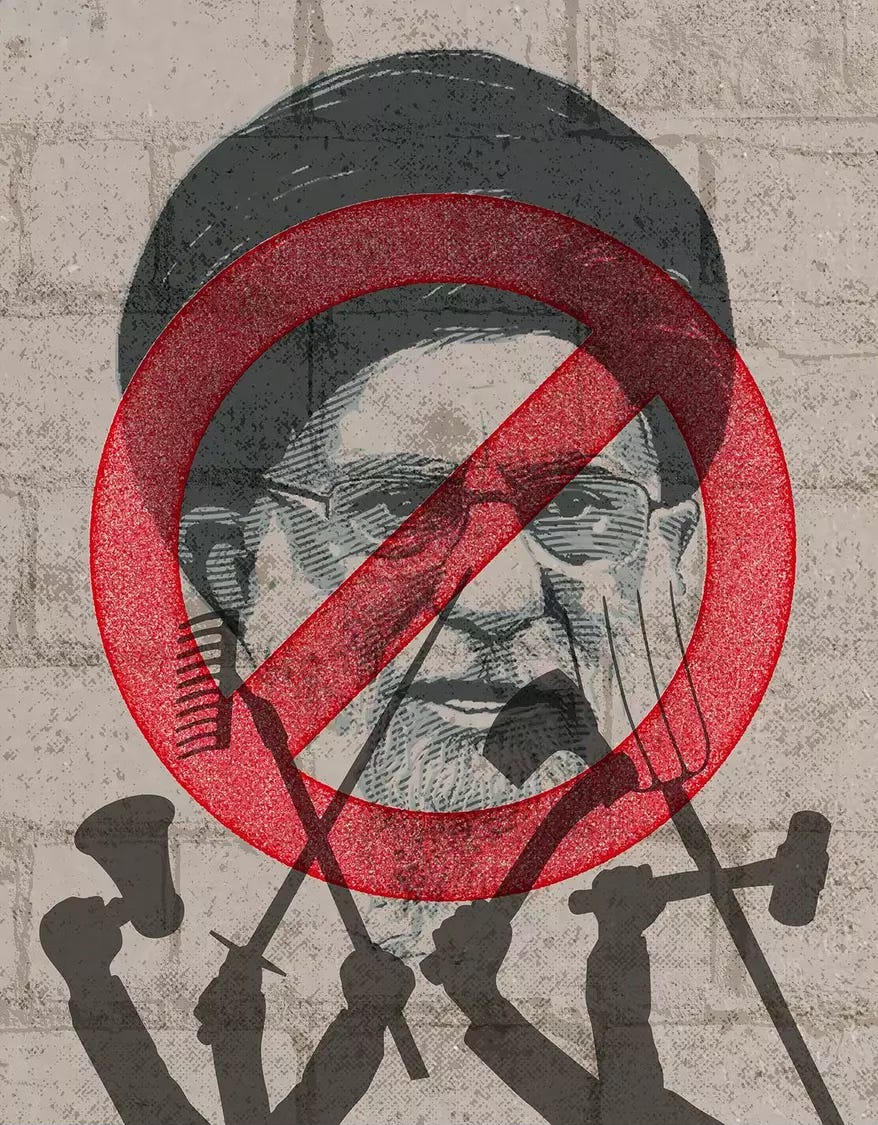
The Vision Was Never Just About Iraq
When Terry Gross asked me in 2003 to outline the strategy behind the invasion, I explained that the neoconservatives around George W. Bush were not simply trying to remove one dictator. They were pursuing a transformational project — a remapping of the entire Middle East through American military power. Here is what I said:
Fresh Air, April 1, 2003 — My words
There’s a group of people in the administration, usually called the neoconservatives, bolstered by columnists and editors outside the administration, who believe that the role of US power should be not just to manage the world but to transform it. What’s the point of being a hegemon if we can’t remake the world in our image? So they see Iraq as the beginning, not the end, of this process.
After Iraq, the idea would be that the people in the neighboring countries — Syria and Iran — would be encouraged to rise up and overthrow their governments with the help, of course, of US troops, who would now be based in Iraq. And this would spread to all the other countries, including Saudi Arabia.
Read that again. Iran was always next on the list. It was written into the doctrine from the start. Few of the neoconservatives of the Bush era, such as Paul Wolfowitz, Richard Perle, Douglas Feith or David Wurmser, remain active, and those that do, such as Bob Kagan, David Frum and Bill Kristol, are mostly Never Trumpers.
But some of the same groups — or their direct intellectual heirs — clustered around AIPAC and the Foundation for the Defense of Democracy and Israeli Prime Minister Bibi Netanyahu, remain. They are operating from the same blueprint. The dream of serial regime change in the Middle East did not die with the Iraq disaster. It went underground, regrouped, and waited.
Iraq was not the end — it was the beginning. Iran was always next on the list.
The Paper Trail: Four Documents That Built These Wars
In 2003, I talked with Terry Gross about four documents that together constituted the intellectual architecture of the Iraq War. They are equally the architecture of the Iran War. I want to revisit them here, because I believe most Americans have forgotten them — and because the current administration is counting on that amnesia.
The 1992 Defense Policy Guidance Document. Paul Wolfowitz, then Undersecretary of Defense for Policy, drafted a guidance document so radical that people inside the Pentagon leaked it to The New York Times to kill it.
It proposed that the United States prevent any other country from challenging American power, globally or regionally. It called for pre-emptive attacks based on the speculation that a country might someday threaten US interests. It specifically contemplated another war in Iraq — just months after the first Gulf War had ended. When it leaked, the outcry forced a complete rewrite. But the ideas didn’t die. They went into a drawer and waited for their moment.
The 1998 Letter to President Clinton. Bill Kristol’s Project for the New American Century organized eighteen prominent policy experts to sign a letter demanding that removing Saddam Hussein become the explicit aim of American foreign policy. Here is what I told Terry Gross about it:
Fresh Air, April 1, 2003
This letter did two things. It told President Clinton that inspections could never work and that the only solution was to go in with military force and take him out. And it was a very effective organizing tool. These guys are smart. They’re dedicated. They know what they’re doing. Many of the signatories ended up in senior positions in the Bush administration.
“Rebuilding America’s Defenses” (2000). The Project for the New American Century’s most ambitious document essentially served as the shadow national security strategy that the Bush administration adopted when it took office. The report noted, “The U.S. has for decades sought to play a more permanent role in the Gulf regional security. While the unresolved conflict with Iraq provides the immediate justification, the need for a substantial American force presence in the Gulf transcends the issue of the regime of Saddam Hussein.” As I described it to Gross:
Fresh Air, April 1, 2003
You read this report and it point for point has been taken up by the administration: large increases in defense spending, specific recommendations on weapons systems, a policy of preemptive attack, the need to move bases from Europe to the Middle East, the expansion of US influence into areas we haven’t been in before. Some might see that as a new form of colonialism. They see it as the spread of democracy and US power.
The 2002 National Security Strategy. Under National Security Advisor Condoleezza Rice’s direction, what had been a fringe position in 1992 became official US government doctrine. The document declared that the United States “will not hesitate to act alone and, if necessary, act preemptively.”
Netanyahu and the neoconservatives saw their opening. Neocon writers began to urge regime change as part of a larger strategy for remaking the Middle East. In June 2002, Michael Kelly wrote that a democratic Iraq and Palestine “will revolutionize the power dynamic in the Middle East…A majority of Arabs will come to see America as the essential ally.”
“Change toward democratic regimes in Tehran and Baghdad would unleash a tsunami across the Islamic world,” claimed Joshua Muravchik in August of that year. Michael Ledeen on September 4, 2002, called for the US to launch “a vast democratic revolution to liberate all the peoples of the Middle East…It is impossible to imagine that the Iranian people would tolerate tyranny in their own country once freedom had come to Iraq. Syria would follow in short order.”
Netanyahu testified to Congress in 2002 claiming, “there is no question whatsoever that Saddam is seeking and is working and is advancing towards the development of nuclear weapons.” He told the Members, ““If you take out Saddam, Saddam’s regime, I guarantee you that it will have enormous positive reverberations on the region.”
Democracy experts, including the Carnegie Endowment’s Tom Carothers, called this vision “a dangerous fantasy.” But in September 2002, President Bush embraced the strategy when he told the United Nations, “The people of Iraq can shake off their captivity. They can one day join a democratic Afghanistan and a democratic Palestine, inspiring reforms throughout the Muslim world.” Bush had embraced the entire expansive strategy.
A decade-long project was complete. And in March 2003, the bombs started falling on Baghdad.
✦ ✦ ✦
How the Fringe Became Policy — Twice
In 2003, I told Terry Gross how this set of ideas once considered extreme had come to dominate the most powerful government in the world. My answer is worth repeating, because it echos what has happened under Trump.
The first mechanism was the appointment process. Scooter Libby helped steer sub-Cabinet appointments so that the Bush administration was, as I put it at the time, flooded with neoconservatives who already knew each other, had already worked out the strategy, and could present it to senior officials with an appearance of unanimity and expertise. The second mechanism was a shock — September 11 — that created a desperate hunger for dramatic action and left a president with limited foreign policy experience vulnerable to a coherent, confident worldview that told him history had chosen him.
Fresh Air, April 1, 2003
We found the perfect marriage between a somewhat inexperienced president on foreign policy who had this evangelical bent and this group of visionaries who were out to change the world. That, more than any other factor — more than weapons of mass destruction, more than terrorism — is what brought us to the battlefields of Iraq.
Today, Trump does not share Bush’s evangelical worldview, but he has something equally powerful: a consuming desire for personal glory and an utter indifference to institutional constraint. The advisors whispering in his ear — Bibi and the network of think tanks and media figures urging him forward — understand that. They have shaped the argument to fit the man. You won’t hear talk of spreading democracy this time. You’ll hear about strength, dominance, Israel’s security, and the Iranian nuclear threat. Different packaging. Same destination.
Substitute “Trump loyalists” for neoconservatives and you have the operating mechanism. Substitute the perceived success of military operations in Iran and Venezuela for September 11 and you have the driver for expansive military action.
You can’t spread democracy on the point of bayonets. History has now proven that twice — and we are beginning to learn it a third time.
What We Warned Would Happen to Iran — and Did
In 2003, Terry Gross asked me what lesson Iran and North Korea would draw from the invasion of Iraq. I told her the evidence was already clear: they would speed up their nuclear programs, not slow them down. They would conclude that the only protection against an American regime-change campaign was a nuclear deterrent. I warned that some in the administration were already talking about applying the same strategy to Iran next.
Fresh Air, April 1, 2003
What lesson will North Korea and Iran draw from the war in Iraq? The evidence so far seems to be that they’re speeding up — the lesson they’re drawing is that they’d better get a nuclear weapon quickly before the United States comes after them. There are some I’ve spoken to in the administration who, after Iraq is over, want to go on to either Iran or North Korea and try the same strategy.
That warning went unheeded. When the U.S. refused to negotiate, Iran accelerated its program through the Bush years. The Obama administration negotiated the JCPOA in 2015 — a triumph of diplomacy that shrank and froze Iran’s nuclear program, placed it under intense international inspection, and gave diplomacy a real chance. In 2018, Trump tore it up. He promised a “bigger, better deal” and delivered nothing. Eight years later, with no deal and a shattered diplomatic framework, he has reached for the same instrument that failed so catastrophically in Iraq: military force.
The result is a potential nuclear catastrophe. Roughly half a ton of highly enriched uranium — enough for multiple weapons — is now somewhere in Iran, unmonitored, in conditions of chaos and conflict. We created this problem. We created it the moment we abandoned the agreement that had Iran’s nuclear program locked in an iron box, surrounded by cameras and inspectors.
The Conspiracy Was Always in Plain Sight
In 2003, when Gross asked whether I was describing a conspiracy, I gave an answer I still stand by completely:
Fresh Air, April 1, 2003
No, because they’ve been quite open about what they think. It’s a conspiracy in plain sight. All you have to do is go read the documents, go to the American Enterprise Institute, read The Weekly Standard, look at what these people say. They are openly advocating this. The one element you do have is that they’re very well-organized — a tight-knit group of people who have been working together for some time. We haven’t really experienced as a country the policy domination we now have from a group of people whose interests transcend the particular administration they’re in.
The documents are still there. The think tanks are still producing them. The same arguments — that Iran is uniquely dangerous, that diplomacy is weakness, that military pressure will produce capitulation or collapse — have been recycled through Foundation for Defense of Democracies reports, The Wall Street Journal editorials, and the same network of columnists and television commentators that beat the drum for Iraq. Read them. They have been telling you what was coming for years.
✦ ✦ ✦
What Comes Next
In 2003 I told Terry Gross that even if the United States prevailed militarily in Iraq, the occupation would be long, bloody, and resistant to the democratic transformation the neoconservatives promised. I said that the force of nationalism — the willingness of people to fight for their land and villages even under a tyrant — was being catastrophically underestimated. That was right, and the United States spent two decades learning that lesson at enormous cost in blood and treasure.
Iran is not Iraq. It is a country of ninety million people with a revolutionary ideology, deep institutional roots, a military that has been preparing for exactly this war for decades, and the ability to close the Strait of Hormuz and send oil prices through the roof — which it has already done. Killing the leadership did not end this regime. Trump and Netanyahu appear not to have planned for any of this.
The war is now an anchor around Trump’s neck. He faces three choices: declare a version of victory and retreat; escalate into something far worse; or try to muddle through in a state of neither active war nor a true peace. No path leads to the outcome that was promised: a compliant, transformed Iran. That was always a fantasy. The Iraq War proved it. And we are about to prove it again, at greater cost, in a more complex country, with a half-ton of unsecured highly enriched uranium as the backdrop.
I said it in 2003 and I will say it again now: these ideas were a conspiracy in plain sight. The documents were public. The advocates were public. The strategy was public. The warnings were public. What was missing, then and now, was the political will to read what was in front of us and refuse.
We did not refuse in 2003. Or not enough of us. We are not refusing now. Or not enough of us. And so here we are. Stuck in another Middle East quagmire.
✦ ✦ ✦
BONUS: Please listen to the latest episode of The Bill Press Pod Reporters’ Roundtable. I guest hosted for Bill while he is on sabbatical in Italy. We discussed the latest on Iran, plus the Supreme Court rollback of voters’ rights, the White House Correspondents Dinner, the faltering economy and prospects for the 2026 elections.
You can listen on Apple Podcast HERE. On other platforms HERE. Or on YouTube, below.
Joe-What you don’t say but I will; the beneficiary of every one of these wars was Israel. The links are clear; to a man, the neocons were all firm supporters of Israel. We stood to gain little, if anything, from dominance over the Middle East. The folly that a democratized Palestine was never in their plans; we’ve seen that with an exclamation point called Gaza! And that was followed by another one in South Lebanon. The territorial expansionist policy couldn’t be more evident.
In a ill-planned attack, we’ve now given Iran an even more potent weapon, one that we can’t see, put in a box, see with a camera or prevent its use.. control over a vital waterway.
Nuclear weapons gave birth to the concept of mutual assured destruction. None of the NPT nations seems to care, let alone acknowledge that Israel thumbs its nose at the NPT while goading the US into war to prevent Iran from acquiring one. If the Iranians had nuclear weapons, their ability to attack their neighbors (Syria, Iraq,Iran, Lebanon) would be dramatically changed.
Small wonder that the Iranians don’t trust the US. We’ve never kept our word with them.
didn't shotgun dick and rumsfeld come into the admin pimping the neocon playbook? you mentioned condi as a conduit, and she certainly was, but cheney and rummy were yammering non stop in front of the cameras...to the point of Iraqi's tossing roses at the conquering heroes that freed them from saddam. of course they did...credit where credit's due...