
The Saudi Nuclear Bomb Program
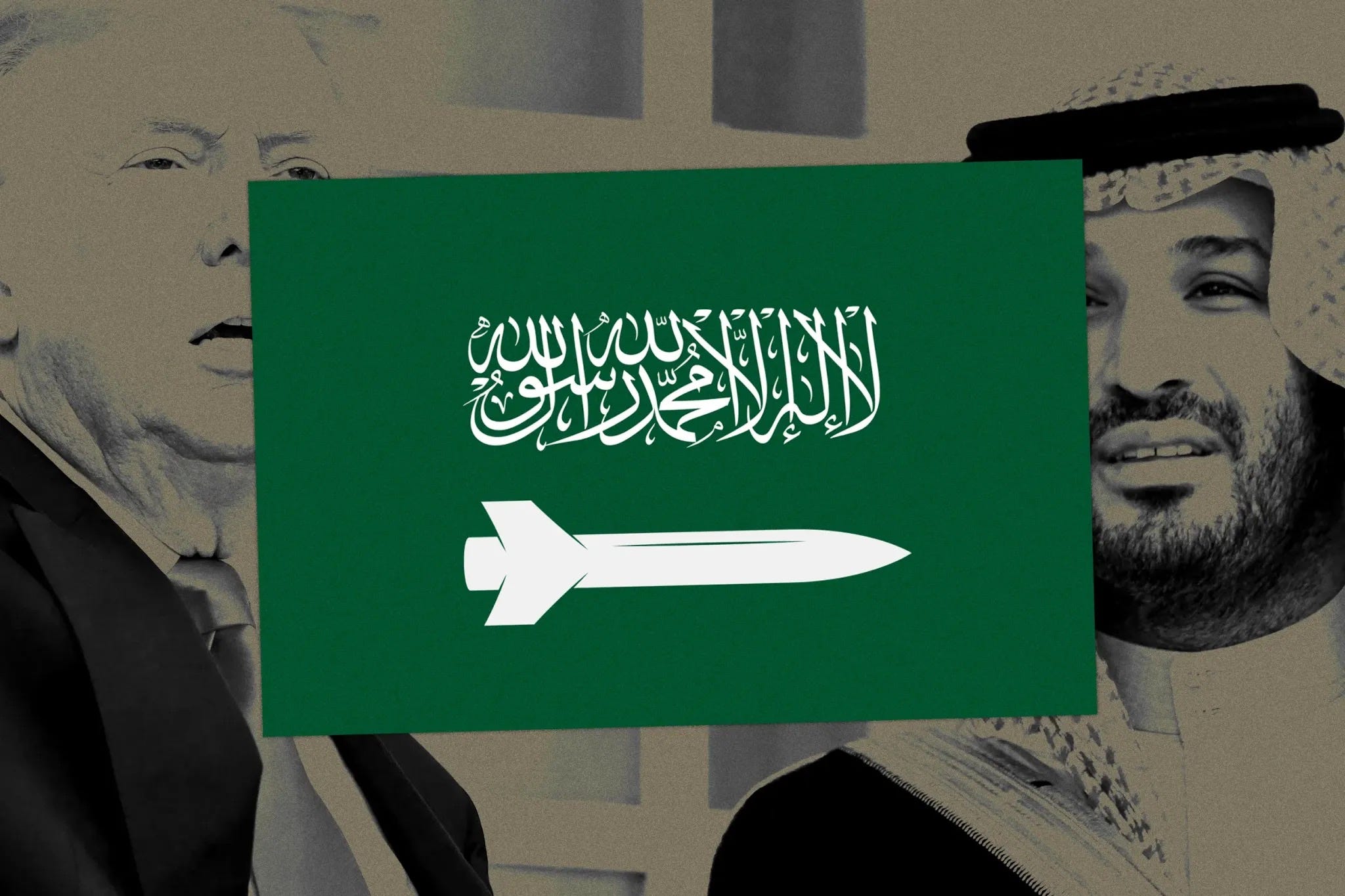
Trump just green-lighted a deal that will give Mohammed bin Salman what he has wanted for a decade - all the ingredients for a nuclear bomb. Chaos will follow. It is the worst nuclear deal in history.

The following post is adapted from an article published July 25 by MS NOW.
The billions of dollars the Saudi monarchy has gifted President Donald Trump’s family have paid off. Trump has caved to Saudi demands to provide the Kingdom precisely the nuclear technology he says is a grave threat in Iranian hands.
In a new agreement signed on Wednesday, Trump agreed to let the Saudis enrich uranium and reprocess plutonium, the two ingredients used in nuclear bombs. The Saudis promise this will be used only for peaceful purposes but Saudi Crown Prince Mohammed bin Salman said as far back as 2018 that “without a doubt if Iran developed a nuclear bomb, we will follow suit as soon as possible.”
Trump’s generosity to Saudi Arabia — which has numerous lucrative deals in place with members of Trump’s family, particularly the $2 billion the Saudis invested in Jared Kushner’s private equity fund — could unleash a flood of new nuclear programs. If the Saudis get this technology, others will demand it, too.
How We Got Here
Ever since the dawn of the Nuclear Age, U.S. policy has denied the ability to enrich uranium and reprocess plutonium to other nations because it is a shortcut to nuclear weapons. The huge and expensive facilities can be developed openly and legally until a government takes the quick jump from making fuel rods to making the cores of bombs. With this deal, Trump has effectively just green-lit a Saudi nuclear bomb program.
That is why in 1946, the Congress passed the Atomic Energy Act, prohibiting the sale or transfer of nuclear weapons technology to any nation, including our allies.
So, how did we get to the point where the United States in now willing to sell this technology to one of the most brutal dictatorships in the world?
In 2013, the Saudis unveiled a plan to build as many as 16 civilian nuclear reactors. Nuclear reactor companies salivated at the prospect of contracts worth hundreds of billions of dollars.
But Saudi nuclear power reactors make little economic sense. Nuclear is the most expensive way to produce electricity, especially since Saudi Arabia sits on an ocean of oil and is ideally suited for much cheaper solar and wind energy production. “When it comes to power generation, it's 10 times more expensive than solar power because they are blessed with an unbelievable amount of sunshine,” Princeton scholar Bernard Haykel told The PBS Newshour, “So, frankly, if you're looking to generate power to liberate more oil from electricity generation, it makes much more sense to use a combination of solar, wind, and gas, natural gas.”
Still, if they just wanted to waste their money on reactors, it wouldn’t be a problem. But they want more. Much more.
Centrifuges for Fuel = Centrifuges for Bombs
Saudi Arabia wants the entire nuclear fuel cycle. They want to make the fuel for the reactors, then reprocess the spent fuel rods when they are used up. The same centrifuges that spin uranium gas to enrich it to the low levels required for nuclear fuel can spin it to the high levels for the cores of nuclear bombs. The same reprocessing plants that can break down used fuel rods for waste disposal can separate out the reactor-produced plutonium in those rods for use in nuclear bombs.
With these plants, Saudi Arabia would have both pathways to the Bomb. The Hiroshima atomic bomb was made of uranium; the Nagasaki bomb, plutonium.

That is why there are strict controls on these fuel-cycle technologies. It is these controls that Prince bin Salman wants the U.S. to waive, including strict inspections. Trump has agreed, dependent on whether a U.S.-Saudi study determines an enrichment facility would be warranted.
Most countries with nuclear reactors do not have such plants. They buy their fuel from the half-dozen or so countries and consortiums that make it. Given the enormous construction and operating costs, it doesn’t make economic sense for a country to produce its own fuel unless it has 20 or more reactors. Saudi Arabia doesn’t yet have one. But it wants an enrichment facility.
This is exactly the issue with Iran. The decades-long dispute has not been over the construction of an Iranian nuclear power reactor at Bushehr, but about Iran’s enrichment of uranium.
Saudi Arabia wants to match that capability. To become a nuclear-threshold state. To have the capability to make the material for bombs should it decide to do so. Just like Iran.
The Folly of Thinking Allies Can Have Nukes, but Our Foes Cannot.
The Saudis want the U.S. to give it a looser deal than the one struck with its neighbor, the United Arab Emirates. In that case, the U.S., under Presidents George W. Bush and Barack Obama, established the “gold standard” for nuclear cooperation. The UAE promised that it would never enrich uranium or reprocess plutonium. The UAE now has an operating power reactor at the Barakah nuclear complex.
In capitulating to Saudi demands, Trump commits a profound strategic error: believing this technology can be trusted in the hands of friends while denied to foes. Even if the worst happens, he thinks it okay for his friends to have nuclear bombs. As a presidential candidate in 2016, Trump told CNN that Japan and South Korea should have their own weapons. Most pointedly, when asked if Saudi Arabia should get nuclear weapons, he responded: “Saudi Arabia, absolutely.”
But when regimes change, the technology remains. Iran’s path to nuclear capability began in the 1970s under Shah Mohammad Reza Pahlavi, when the Nixon administration approved his plans for dozens of nuclear power reactors and agreed that he could enrich uranium and even process plutonium.
The Shah did not survive to implement his plans, and the Islamic Republic that replaced him at first rejected this “Western technology” but changed its mind during the Iran-Iraq war in the 1980s, restarting the nuclear program, including secret efforts on bomb technology. Even if the Saudi monarchy does not build a bomb, will it still rule the nation in 20 years, when the nuclear plants are fully operational? Will militant jihadists rule, inheriting the bomb program Trump gifted his friend?
Nor is the risk just regime change. Israel, Pakistan, India and North Korea all secretly and illegally began their bomb programs using nuclear technology acquired for civilian use, in violation of numerous bi-lateral and global agreements prohibiting these nations from doing just that.
Is this a done deal? Not necessarily. In 2023, when President Joe Biden tried for a “grand bargain” with Saudi Arabia that would have traded nuclear technology and advanced weaponry for recognition of Israel, liberals and conservatives united to eventually kill the deal.
Twenty senators wrote in opposition to the proposed Biden plan, and a politically diverse group of nuclear proliferation experts and former officials signed a letter organized by the right-leaning Foundation for Defense of Democracy (FDD), a strong proponent for war with Iran. “Riyadh does not need uranium enrichment to produce peaceful nuclear energy,” the letter argued, “Enrichment could bring Saudi Arabia to the brink of acquiring nuclear arms, and U.S. policy should prohibit it.”
And there’s opposition from the same circles to Trump’s even more generous deal. “A bad U.S. nuclear deal with Saudi Arabia is coming for congressional review,” wrote Andrea Stricker, Deputy Director and Research Fellow of FDD’s Nonproliferation Program, on Wednesday. “Congress should block it. If it does not, one hopes the policy will be reversed by a subsequent administration before too much damage is done.”
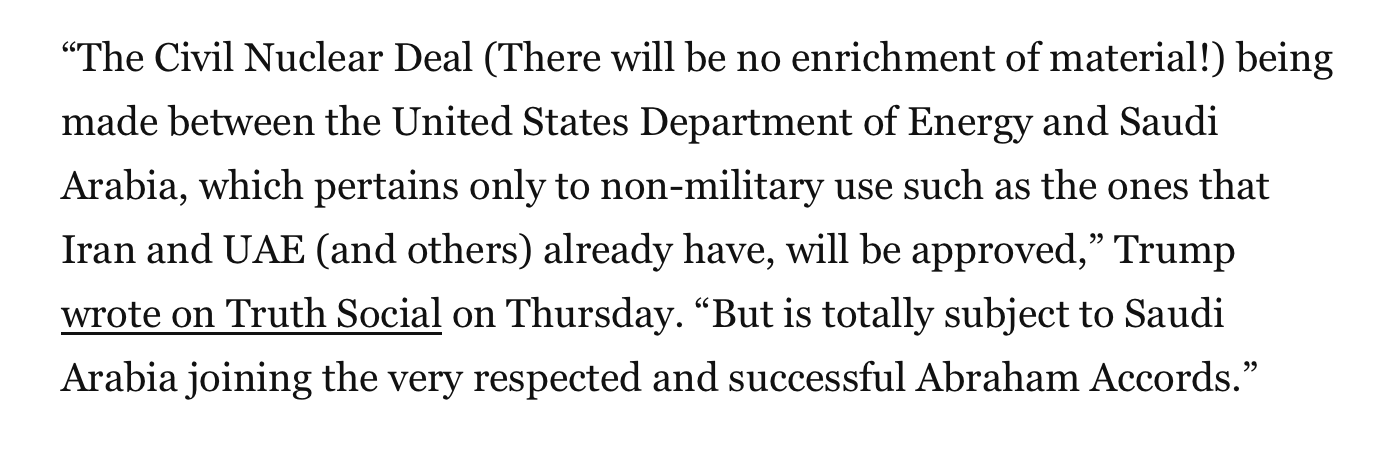
Stricker is right. The outcry over the deal forced Trump to pledge on Thursday that the contracts would be conditioned on Saudi recognition of Israel - similar to Biden’s deal but now highly improbable given Israel’s destruction of Gaza and continued violence in the West Bank.
Does Trump even mean it? Or is it just something he said to get through the day a quell opposition until he can push the deal through. His Truth Social post contained another lie: that there would be no enrichment. Of course there will be enrichment. That is the whole point of the deal.
Trump’s tangle of lies, his deep ignorance of the deal he approved then walked back, his inability to even make a binding agreement (see the MOU with Iran, the Gaza Peace Plan, the tariffs, etc.) may sink the pact.
But don’t count on it. Saudi influence in Washington is powerful, particularly with Trump and his business partners who could profit handsomely from the deal. It will take an all-out effort to block what will be the worst nuclear deal in history.