

Donald Trump says he was surprised by Iran’s reactions to his attacks. “Nobody thought they were going to hit” the Gulf countries, he claimed.
Nonsense. Iran’s actions were completely predictable, and in fact, have long been predicted.
Conservatives in Washington have been talking about attacking Iran ever since a 1979 popular revolution overthrew the dictatorial Shah Mohammed Reza Pahlavi placed on the Peacock Throne in 1953 by the United States and the United Kingdom. For just as long, experts have warned of the foolishness of such a war. Every president from Ronald Reagan on concluded that the costs far outweighed the risks.
One of the peak campaigns for war on Iran occurred in the 2010-2015 period when President Barack Obama sought a diplomatic solution to Iran’s growing nuclear program.
I was then president of Ploughshares Fund. It was then a global security foundation, funding and connecting experts and advocates in effective, collective campaigns. One of the projects we funded was a report by nationally recognized military and diplomatic leaders to weigh the benefits and costs of military action against Iran.
Published in 2012, the report helped create political space for the successful diplomacy Obama undertook. The next year, Secretary of State John Kerry led a team of highly qualified experts to negotiate an interim agreement (finalized in 2015) that successful blocked all of Iran’s pathway to a bomb.
If Donald Trump had not pulled out of that deal in 2018, Iran would not pose a nuclear threat today. It would not have 440 kilograms of 60 percent enriched uranium that it could spin in advanced centrifuges into material for the cores of a bombs within weeks. It prevented an Iran Bomb and an Iran War.
Below, is part of the executive summary of the report. It is followed by excerpts from the full report on the costs of war with Iran.
It is riveting reading. These expert warnings are dead on accurate. They closely mirror what has unfolded over the past five weeks. If Trump had listened to these or similar experts (instead of Bibi Netanyahu and Mohamed bin Salman) we would not be stuck in an illegal, unnecessary, costly war today.
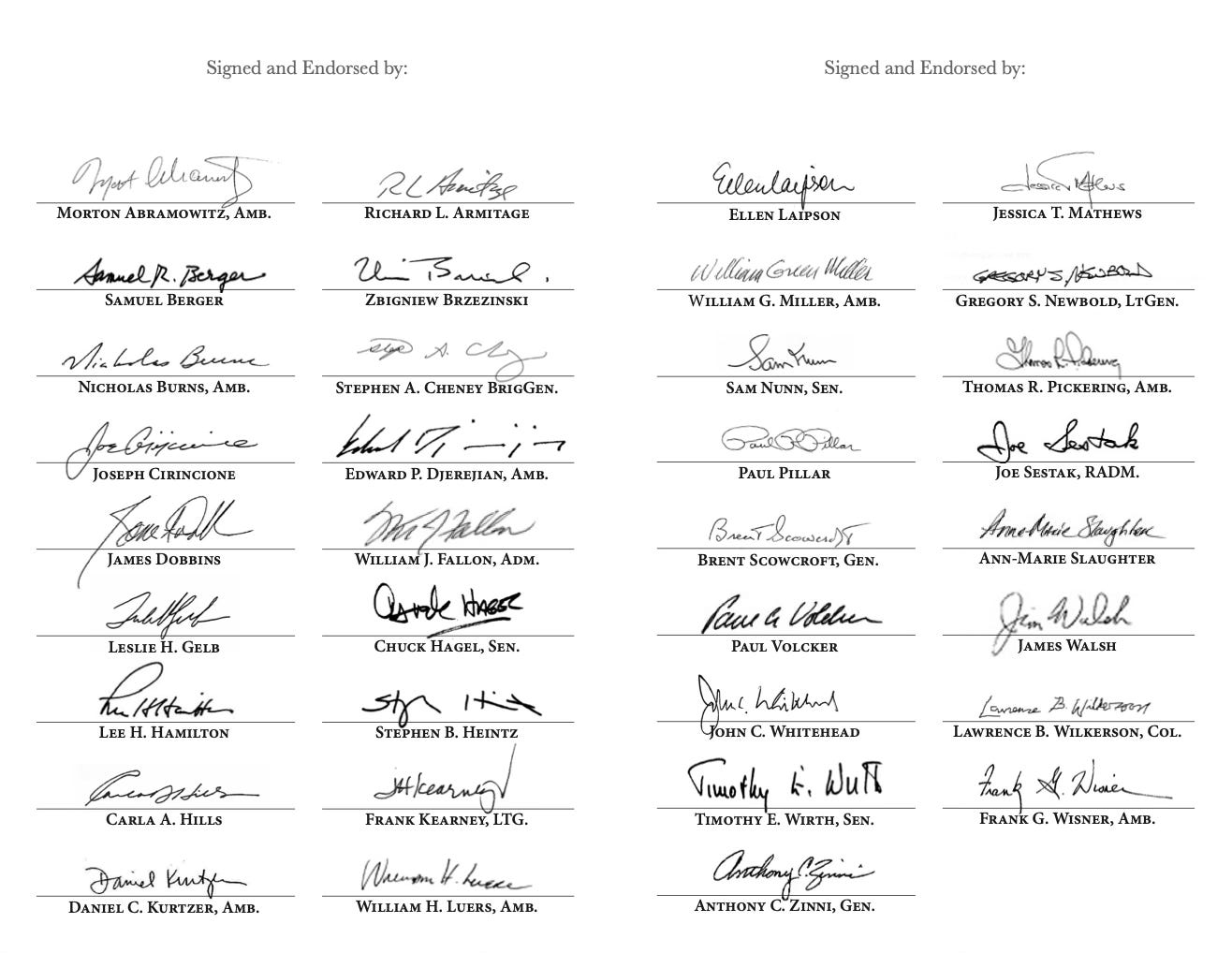
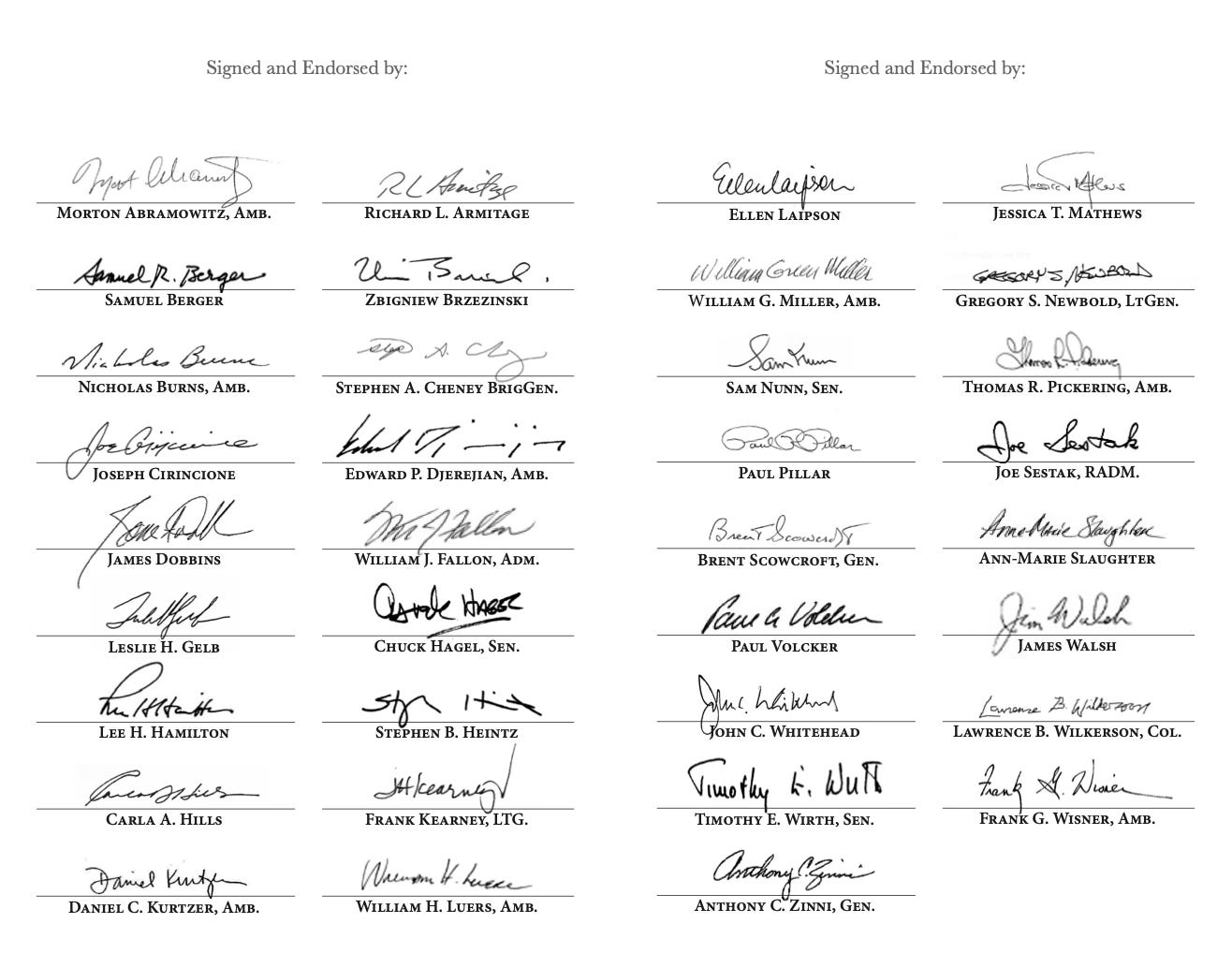
The report, Weighing the Benefits and Costs of Military Action Against Iran, was discussed, prepared and endorsed by 35 senior experts, including Gen. Anthony Zinni, Zbigniew Brzenzinski, Sandy Berger, Carla Hills, Adm. William Fallon, Gen. Stephen Cheney, Jessica T. Mathews, Sam Nunn, Ellen Laipson, Nicholas Burns, Ann-Marie Slaughter, Rep. Lee Hamilton, Amb. William Luers and Richard Armitage.
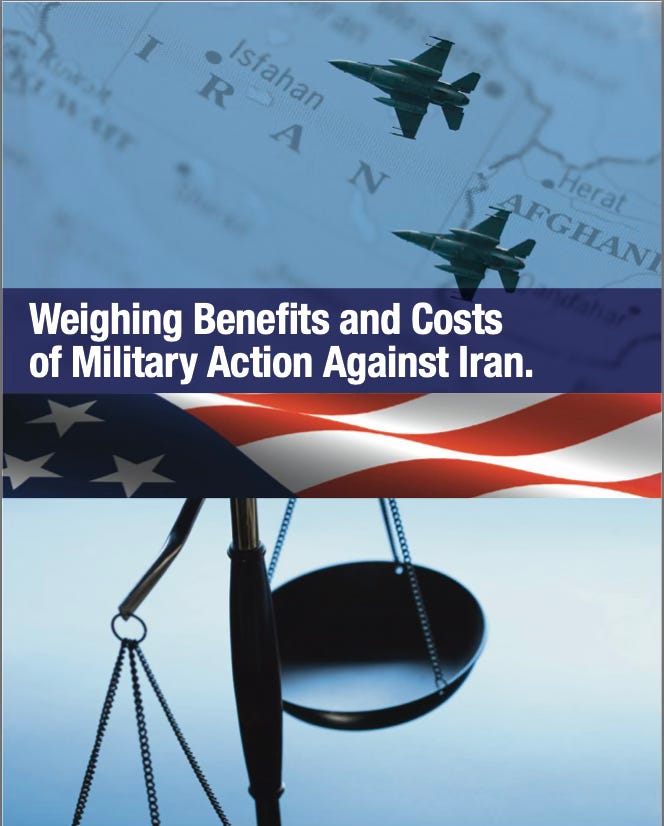
The report took an analytical approach, considering the resources and planning that military action would require and concluded that U.S. action, including airstrikes, cyber-operations, and special forces operations, could delay Iran’s nuclear program by up to four years. But the costs would exceed the benefits.
The report found that the benefits of US military action with the objective to delay Iran’s nuclear program for up to four years could include:
Damage or destroy Iran’s major enrichment facilities;
Damage Iran’s military capabilities and ability to retaliate directly;
Demonstrate to allies and friends U.S. seriousness and credibility;
Deter nuclear weapons proliferation elsewhere.
Broader objectives such as regime change, damage to Iran’s regional influence or capitulation to U.S. demands, would require sustained, continuing and expanded air and sea warfare, if not a land occupation beyond the scope of Iraq and Afghanistan combined, the report found.
The report concluded that the costs of U.S. military action could include:
Direct Iranian retaliation against U.S. and Israeli facilities, military and civilians around the globe;
Indirect retaliation against Israel by proxies such as Hezbollah with the same objectives;
Potential for escalation leading to a broad regional war;
Significant weakening of global support for sanctions and negotiations, reducing pressure on the regime and improving its prospects for rebuilding;
Increasing the likelihood Iran will build a nuclear weapon;
Global economic instability provoked by an oil price spike, as well as regional political instability;
Damage to U.S. reputation and heightened credibility for extremist groups, particularly in the Muslim world.
Weighing the Benefits and Costs of Military Action Against Iran [excerpts]
The initiation of preventive military action against Iran, even with limited objectives, could be the beginning of a war entailing all of the uncertainties and unanticipated consequences so familiar to those who have experienced or studied military conflicts.
Obviously, any substantial U.S. commitment to military action against Iran would create a highly unstable and combustible relationship with one of the largest and most powerful nations in the region. Some of the costs of an Israeli and/or American military action would be realized immediately. (We are talking here about the costs of Iranian retaliation, not the financial costs of conducting an offensive military campaign, which would be significant, particularly if the U.S. were to carry out thousands of sorties and decide it had to return to the use of force periodically for years to come.) Attacking Iran would also have important longer-term regional and global consequences for the United States. The long-term and even the near-term costs of military action are difficult to estimate, because of uncertainties about Iran’s reactions and the reactions of other nations, and because of the high likelihood of unanticipated and unintended consequences.
In this section of our paper, we start by providing estimates of the costs of direct and indirect Iranian retaliation, and then offer some more speculative assessments of the very critical regional and global implications of attacking Iran.
Costs of Direct Iranian Retaliation
Some argue that Iran would be inclined to hold back in its response to an attack, so as not to provoke an even larger conflict with the United States. We believe, however, that Iran would retaliate, costing lives and causing damage to U.S. property and assets in the region. Iran could engage in at least token missile/rocket strikes against the attacker, targeting sites in Israel or U.S. facilities in the region. Iran’s ballistic missile program has developed in parallel to its nuclear program, with both making substantial progress in the past several years (although sanctions have slowed development in both programs). According to unclassified estimates, Iran probably has at least two dozen and possibly more than 100 conventionally armed ballistic missiles [2500-3000 missiles by 2026] capable of striking most of the region, including Israel—although this capability may be blunted by ballistic missile defense systems that the United States is reportedly in the process of deploying in the region.
We do think it possible that the Iranians might limit the scope of their retaliation, in order to develop support and sympathy from key regional states and the broader international community, gauging that they would gain politically from being perceived as the victim.
Retaliation against Israel. In response to an Israeli strike, Iran could launch missiles at Israeli cities. While Iran’s missiles are highly inaccurate and Israel’s missile defenses (which would likely be supported by U.S. systems) could intercept many of these weapons, some could get through. Although Israel could anticipate some of Iran’s likely targets and direct most of the affected civilians to bomb shelters, there would inevitably be casualties and property damage.
Some Israelis and others have suggested that since earlier Israeli surprise attacks on Iraq’s Osirak and Syria’s Deir ez-Zor reactors provoked no retaliation from either country, Iran also might not retaliate. This seems unlikely to us. While retaliation against Israel would risk drawing the United States into the conflict, it might be necessary for domestic Iranian political reasons, and it would be understandable to many in the international community who would condemn the Israeli military action. Iran could target Israeli airbases where aircraft used in the strike are located, or the Israeli nuclear complex at Dimona. Iran might even estimate that such a proportional response might not draw the U.S. into the conflict.
Closing the Strait of Hormuz. Iran could attempt to close the Strait of Hormuz in retaliation for an attack. Nearly 20% of world exports of petroleum—including Iran’s own exports—pass through the Strait of Hormuz. Any effort to block the Strait could disrupt the global oil and natural gas markets (in addition to blocking the main artery for export of Iran’s own oil), resulting in a large increase in petroleum prices and potentially alienating important nations, such as China, which otherwise would likely be sympathetic to an Iran that has been attacked seemingly without clear provocation. Nonetheless, Iran might calculate that threats to close the Strait could galvanize international pressure on the U.S. to de-escalate.
Despite the overmatch enjoyed by the U.S. Navy and possible coalition partners, Iran might succeed in closing the Strait for days or even weeks by deploying a substantial number of mines and then using its naval forces and land-based anti-ship missiles to hinder efforts at clearance. Such an outcome obviously would drive oil prices higher.
Even if Iran did not seek to close the Strait, an attack on Iran would likely produce an anticipatory spike in oil prices—in fact, mounting tensions with Iran have already contributed to a price increase. Escalating tensions and naval skirmishes could further rattle markets and produce additional price spikes. There is also the possibility that defensive measures taken by the Iranians could be misinterpreted, or that rogue actions by elements of the IRGC Navy could create incidents in the Persian Gulf, creating an inadvertent naval escalation in the Strait.
Escalation. Any Iranian retaliation could lead to Israeli or U.S. responses that in turn might provoke additional Iranian responses. The consequences are uncertain, but an escalation spiral certainly could result, with either or both sides taking actions that neither side contemplated before an initial strike—particularly since what one side sees as a completely justified retaliation may very well be perceived by the other side as a deliberate escalation. Given the “fog of war,” high levels of mutual distrust, the absence of communication among regional combatants, and the ability of events to overtake even the most careful planning, miscalculation and uncontrollable escalation to full scale combat cannot be discounted.
Regional and Global Costs
The long-term and global costs to U.S. interests are even more difficult to estimate. Recognizing that these may be speculations and that there is disagreement on these points, we offer the following assessments of possible global costs.
A potential breakdown in global solidarity against Iran’s nuclear program. The United States would likely seek some kind of international mandate for military action against Iran, and attempt to put together a large multinational coalition. But if the U.S. and/or Israel end up attacking Iran’s nuclear program without such a mandate, hard-won international support for maintaining sanctions against Iran could be substantially weakened. China and Russia would loudly condemn military actions against Iran, and some European nations might pull back from a sanctions regime after such attacks. Iran would be seen by many around the world, Muslims and non-Muslims alike, as the victim of unjustified American and/or Israeli military action.
With the breakdown of cooperative international efforts to isolate Iran, there is the possibility that Iran might receive new support for its military capacity. For example, Russia might be willing to sell Iran advanced surface-to-air missiles (SAMs) that would make future attacks on Iran more costly and difficult. Russia is currently withholding sales of these systems because they fall under U.N. sanctions, but this decision and others could be revisited after strikes on Iran. Also, Iran now faces severe limits on its ability to acquire from abroad a variety of dual-purpose materials and components for its centrifuges and other nuclear technology. States that see Iran as the victim of an unjustified attack might become more willing to share information and material with Iran. This could potentially enable Iran to produce more advanced centrifuges than the country is currently able to produce, given material and technical shortages.
Increased likelihood of Iran becoming a nuclear state. Any sort of military action that could lead to outright war would have a significant impact on the possibility of reaching a more permanent political resolution of concerns about Iran’s nuclear program (as well as concerns about Iran’s regional role and many other issues that are central to U.S. security interests in the greater Middle East). Of course, there is a chance that punishing aerial attacks might drive Iran to the negotiating table—although we know of very few historical cases in which air strikes combined with other forms of pressure (but without the use of ground troops) produced such a result. Rather, once negotiations are abandoned for military action, it would become extremely difficult to pursue diplomatic discussions unless and until the Iranian regime surrenders or capitulates—which seems unlikely, although not impossible. As asserted above, in order to achieve Iran’s capitulation or to bring down the regime, the United States would probably have to use ground forces and wage a long-term war.
In fact, we believe that a U.S. attack on Iran would increase significantly Iran’s motivation to build a bomb. According to one senior military official, this was the conclusion reached by many in the Bush administration. While there is no evidence that Iran’s Supreme Leader has decided the country should develop a nuclear weapon, many observers believe that Iran’s leaders want the country to be capable of making a bomb if they perceive one to be needed.
After an attack or repeated attacks, Iran’s leadership could become more convinced than ever that regime change is really the goal of U.S. policy. The decision to build a bomb would be taken for national security reasons, with the assumption that a nuclear weapon would help to head off any future or sustained U.S. military action. But building a bomb would also redress the humiliation of being attacked and restore national pride, which has been a major driver of Iran’s nuclear program for a decade.
Greater regional and global instability, including the possibility of increased terrorist recruitment. A U.S. and/or Israeli preventive military action against Iran could combine with rising populism and the uncertain political developments associated with the “Arab awakening” and the Syrian civil war to create a toxic mixture, perhaps contributing to increased sectarian conflict and regional war. It is particularly difficult to anticipate how a U.S. attack on Iran would interact with the dynamics of conflict in Syria, given the close nexus between the Iranian regime, the Assad regime in Syria, and Hezbollah, and the United States’ vocal support for the Syrian rebel forces.
While a United States-led military action against Iran could temporarily improve official U.S. relations with the governments of Saudi Arabia and some of the Gulf States, the impact on the broader Arab public is likely to be negative for U.S. interests and leverage in the region, particularly in Egypt. An attack on Iran would most certainly provoke increased hostility toward Israel, which could escalate into a regional conflict or, at the very least, undermine prospects for progress on the Israeli-Palestinian peace process, which would have a direct effect on U.S. security interests. Much of the impact on the region would depend on the nature and extent of the initial military actions, whether it is only Israel or the U.S. and Israel, the nature of Iranian retaliation, and the subsequent Israeli and/or U.S. responses. Large-scale Iranian retaliation would add significantly to the likelihood of opening up a broader conflict in the region, through the escalation spiral described above.
In addition, we believe that an attack on Iran would enhance the ability of radical Islamist groups, including Al Qaeda, to recruit in the region. It is hard to quantify the scale of this effect, but if Iraq and Afghanistan are models, one could anticipate that an attack on Iran will boost the popularity of groups and leaders who claim that the U.S. is the enemy of Islam. Even though Al Qaeda’s Sunni leaders might be pleased by attacks against the Shiite Iran, they would nonetheless welcome the resulting international Muslim outrage, which would create fertile ground for expanding their ranks.
Iran might also use its connections to Shiite groups in Iraq to encourage attacks on U.S. interests there, in the region at large, and globally. While U.S. combat forces have departed from Iraq, thousands of U.S. military support personnel, diplomats, civilian contractors, and business people remain. Retaliation in Iraq could take the form of large-scale rocket attacks against U.S. diplomatic and military facilities or attacks on convoys; or it could be disguised as criminal activity, such as kidnapping U.S. citizens.
Globally, in addition to rattling global markets and increasing the price of oil in the short term, a new conflict in the Middle East would be a major disruptive factor in a world economy that is struggling to regain its footing. While this paper does not attempt to estimate the global economic costs of a single or a series of preemptive strikes against Iran, we gauge that the resulting instability could bring even more uncertainty to global markets, currencies, and recovery.
Reduced regional and global influence for the U.S. One of the most serious but most difficult to quantify costs of military action against Iran could be damage to U.S. reputation and standing in the world. Such damage could occur whether it is Israel or the U.S. that takes military action. If Israel takes military action over official U.S. objections, the perception will be that the U.S. has tacitly approved the attack. If the U.S. attacks, especially without a very clear and widely convincing indication of a decision by Iran to build a nuclear weapon, the perception will be that once again the U.S. has taken preventive military action in a unilateral fashion. Moreover, if either Israel or the U.S. were to attack the Islamic Republic of Iran, Muslims around the world would have even more reason to believe that the U.S. and Israel are at war with Islam. Even though some Arab leaders would be privately relieved, Muslim world leaders in general would condemn the attack. We believe that U.S. stature and influence in the region would suffer.
To be sure, some policy analysts contend that after years of declaring that an Iranian nuclear weapon is unacceptable, the failure to take military action would undermine America’s global credibility. These two differing judgments highlight the dilemma faced by the United States as it weighs various policy options toward Iran.
We acknowledge a third possibility as well—that the failure to attack and the decision to attack both could have some negative reputational consequences for the United States. The challenge then would be to determine which of those consequences are most probable, important, and lasting.
What about regime change? We cannot know for certain how the initiation of military action against Iran would affect the regime’s grasp on power. But history and recent experience hold some clues. We note that military attacks by other nations have seldom led to regime change, absent the use of ground forces to occupy territory. Indeed, the 2011 air campaign in Libya suggests that, even with local rebel forces active on the ground, air strikes would need to be sustained for an extended period and supplemented by on the ground support from other nations’ professional militaries in order to produce a change in leadership. Of course, there is always the possibility that an effective attack on Iran’s nuclear and military facilities would demonstrate the impotence and confirm the failed policies of the Iranian regime. Such a demonstration could hearten resistance and perhaps signal the beginning of a change of leadership in Iran. But in our view, air strikes alone are not likely to lead to regime change, regime collapse, or capitulation.
Would military action against Iran increase or undermine support for the regime among Iran’s population? The former seems more likely, judging by the strong support showed by the Iranian public for their leaders after the Iraqi attack in 1982 and throughout the grueling, eight-year war that followed.
Even if regime collapse could be produced by a prolonged campaign of air attacks combined with covert and cyber attacks, and drone activity (an outcome that we view as unlikely), it is not necessarily the case that Iran or the region would be more stable as a result.
…..
We offer this rigorous assessment by a bipartisan group of national security professionals in an election year in order to help de-politicize discussion of a highly charged issue. We hope the facts and professional judgments arrayed in this paper will help citizens and leaders alike weigh the benefits and costs—both immediate and long-term—of using military force against Iran.
September 2012
There is much more in this comprehensive, prescient report. To read the full report, please click here.
This is absolutely astonishing. Every single word.
Joe writes, "If Donald Trump had not pulled out of that deal in 2018, Iran would not pose a nuclear threat today."
The major provisions of the JCPOA were due to expire THIS YEAR, with the rest going a few years later. There's no telling what would have happened then.
The price tag for the JCPOA was that Iran got access to a LOT more money, which they used to fund Hamas, Hezbollah, the Houthis, fueling conflict like Oct 7, and everything which resulted from it. The destruction of Gaza was born in Tehran.
The JCPOA was a classic political move. If a politician doesn't want to solve a problem, they kick the can down the road for some future politician to deal with. And that moment has now come.
Also Joe, as a fellow Democrat, you are missing the following very important factor:
=========
The slaughter of 30,000 innocent Iranians in 48 hours, as part of a consistent ongoing campaign of mass murder going back decades is in itself a sufficient justification for the Iran war.
=========
You sincerely believe you are being a good Democrat. But by ignoring this Biblical scale crime which requires a response from civilized people, you are actually denying the moral values which form the foundation of the Democratic Party. Democrats stick up for and defend people in trouble.
Sadly, you are not alone. Nearly the entire Democratic Party from the leadership on down is ignoring the great crisis of Iranian people as they face their moment of greatest need and opportunity. And today's Democrats will mostly all now deny this with transparent dodge and weave distractions which utterly lack credibility.
I'm a life long Democrat. And I'm sick of this crap. And I won't be providing my vote to any national Democrat until they convince me they aren't part of it, which I don't expect to happen.